
Loading...
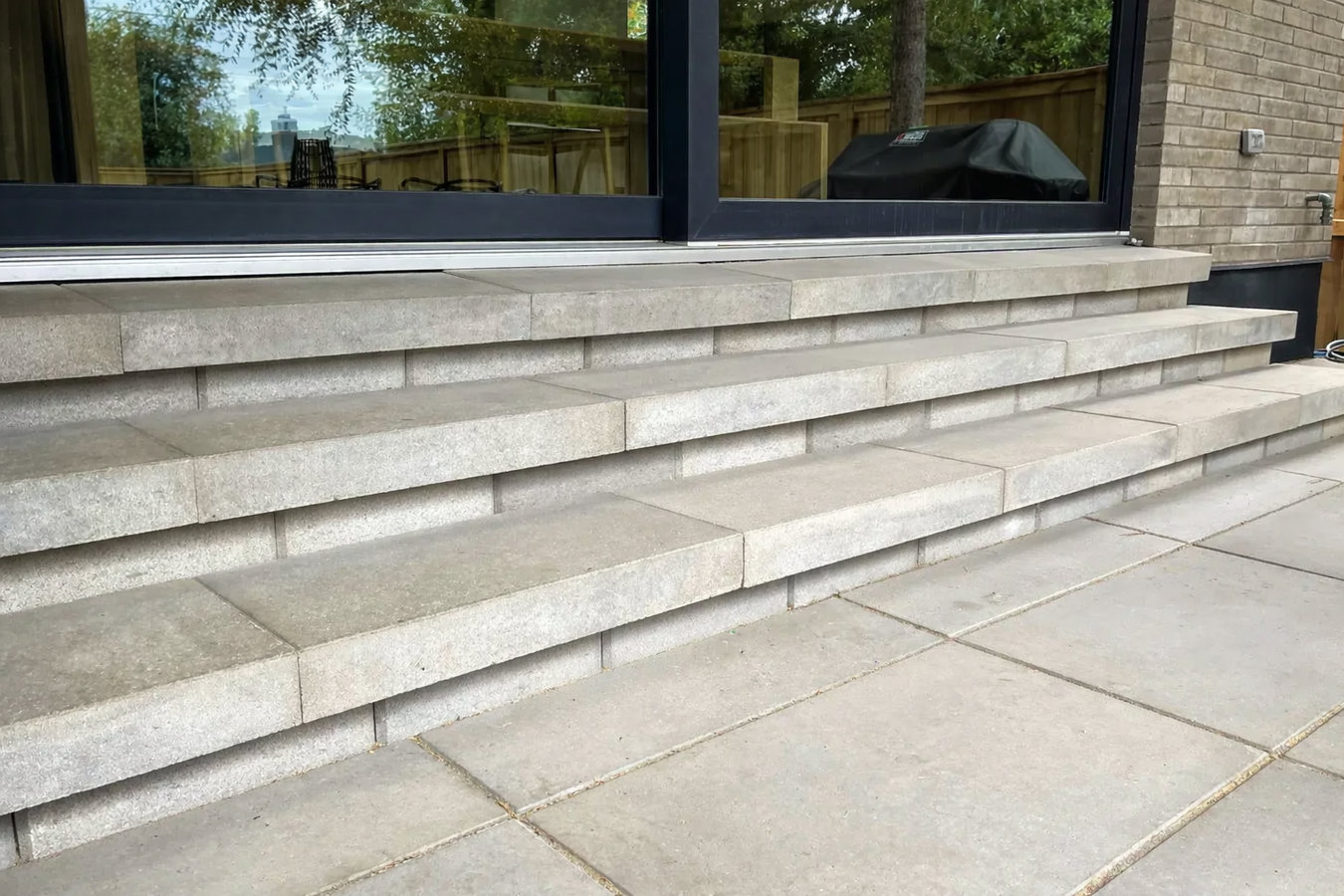
Crumbling, cracked, or shifted steps are a safety hazard - and a patching job that fails every winter costs more than a replacement. We build concrete steps in Champaign that hold up through freeze-thaw cycles and clay soil movement.
Concrete steps construction in Champaign means demolishing your old steps, excavating and compacting the ground underneath, building a wooden form in the correct shape, and pouring a finished slab - most residential jobs take one to two days on-site with a 24- to 48-hour wait before the steps can be used.
Most homeowners in Champaign call us when their front or back steps have cracked and shifted to the point where patching is no longer working. The problem is almost always underneath the surface - a base that was not compacted properly, or clay soil that has moved with years of wet and dry seasons. Once steps have started to tilt or pull away from the house, no amount of surface patching will fix the underlying movement. If you are also planning to update the walkway leading to your steps, concrete sidewalk building pairs naturally with a step replacement to give the whole front entrance a consistent finish and grade.
Well-built concrete steps can last 30 to 50 years. The difference between that and steps that need patching every year comes down to base preparation and surface finish - both of which happen before anyone can see the final result.
If you have patched the same cracks and they reopen after each Champaign winter, the problem is underneath - not on the surface. Repeated freeze-thaw cycles work on those cracks all season long. When cracks keep coming back faster than you can fill them, replacement is the more cost-effective path.
If your steps no longer sit level - one side higher than the other, or a visible gap between the steps and your door frame - the base has shifted. This is common in Champaign due to clay soil movement with moisture. Uneven steps are also a tripping hazard, and the gap at the top can let water into your foundation.
If the top layer is peeling off in thin flakes or the edges crumble when you press on them, the concrete has started to deteriorate from the inside out. This is often caused by years of rock salt use combined with freeze-thaw damage - a very common combination in Champaign. Once the surface starts flaking, the deterioration accelerates on its own.
Steps should shed water off the tread surface - if water pools on them after rain, the slope is wrong or the concrete has settled into low spots. Standing water accelerates freeze-thaw damage through every Champaign winter and makes the surface slippery. Each season without a fix makes the problem worse.
We handle step projects of all sizes in Champaign - from a simple two-step back stoop to a full front staircase with a wide landing. Every job starts with demolishing and hauling away the old steps, preparing the soil and compacting a gravel base, building the wooden form, and pouring the finished slab. For homeowners who want to tie the new steps into a larger outdoor project, slab foundation building is sometimes needed when the area around an entrance requires a stable concrete pad below the steps.
Surface finish is applied during the pour - a broom finish is the most common choice because it provides grip in wet conditions without being rough underfoot. We also offer exposed aggregate and stamped finishes for homeowners who want something more decorative. Each tread is formed with a slight forward slope so water runs off rather than collecting, and control joints are cut to guide any natural movement in the slab. We pull the required permit and coordinate the city inspection so the process is fully handled for you.
Best for steps that have shifted, crumbled, or are past their useful life - demolition, base prep, new pour, and finishing handled completely.
For homes adding steps to a new entrance or replacing wood steps with a permanent concrete alternative - full site preparation included.
For front entrances or elevated doors where a wider landing at the top or bottom improves safety and usability for daily traffic.
For homeowners who want their steps to complement the exterior of the house - broom, exposed aggregate, or stamped finishes available.
A large portion of Champaign's residential neighborhoods - including areas near the University of Illinois campus and established streets on the north side - were built between the 1940s and 1970s. Steps from that era were often smaller than current safety standards recommend and built on minimal bases. After 50 to 60 years of central Illinois freeze-thaw cycles and Champaign's clay-heavy soil shifting beneath them, many of these original steps have cracked, tilted, and started to crumble. Homeowners in Rantoul and Bloomington deal with the same soil and climate conditions - we work across all 12 communities in our service area with the same approach to base preparation.
The clay soil under most Champaign properties absorbs water and expands, then contracts again as it dries. That seasonal movement is what causes steps to pull away from the house, tilt to one side, and create the gaps that let water in. Addressing this requires proper base excavation and compaction before the pour - not a thicker surface layer. We also see homeowners cause additional surface damage by using rock salt for de-icing, which works by drawing moisture into the concrete and accelerating freeze-thaw breakdown. New steps built here need to be sealed and maintained correctly to get their full lifespan. We walk every customer through what to use and what to avoid before we leave the job.
Call or submit the form. Tell us how many steps you have, whether there is a landing, and whether they are at the front or back of the house. We will schedule a free on-site visit - usually within a few days - to measure and assess before giving you a price.
The site visit typically takes 20 to 30 minutes. We measure, check the existing steps, and look at drainage. You get a written estimate that breaks down what is included - not just a single number - so you know exactly what you are approving before work begins.
We apply for the required City of Champaign building permit - typically a few business days to process. On the first day of work, the crew breaks up and removes your existing steps. Expect jackhammer noise for an hour or two - all debris is hauled away by the crew.
The crew excavates, compacts the soil, and lays a gravel base before forming and pouring. You can walk on the steps carefully after 24 to 48 hours. The city inspector visits to sign off, and we walk you through care and maintenance before calling the job done.
We respond within 1 business day and provide written estimates at no charge. Champaign contractors book up fast in spring and summer - reach out now to secure your spot.
(217) 803-9330Champaign's clay-dominant soil is the underlying cause of most step failures in this area. We excavate, compact, and install proper drainage gravel under every set of steps we pour - the step that does not shift or sink starts with the ground work, not the concrete.
We handle the City of Champaign building permit and the city inspection on every eligible project. Permitted work is on record and protects your investment if you sell your home. For current permit requirements, see Champaign Building Safety.
Every set of steps we build gets a textured surface finish - typically a broom finish - that sheds water and provides grip in wet conditions. The American Concrete Institute standards for freeze-thaw resistance inform the mix and finish we use on every Champaign job.
We have completed step projects in Champaign and 11 surrounding communities. Local knowledge of soil conditions, permit requirements, and housing stock means you are not getting a one-size-fits-all job from a contractor who has never worked in your neighborhood before.
The steps we build are designed to handle Champaign winters, not just look good in the first week after installation. That means the right base, the right finish, and a customer who understands how to maintain them - which we cover before we leave every job.
When the ground around your entrance needs a stable concrete pad before steps can be installed, slab foundation work comes first.
Learn moreReplace or extend the walkway leading to your steps for a front entrance that works as a complete, consistent system.
Learn moreChampaign crews book up fast in spring - reach out now for a free written estimate and lock in your project before the busy season fills.